How commercial jetting differs from residential
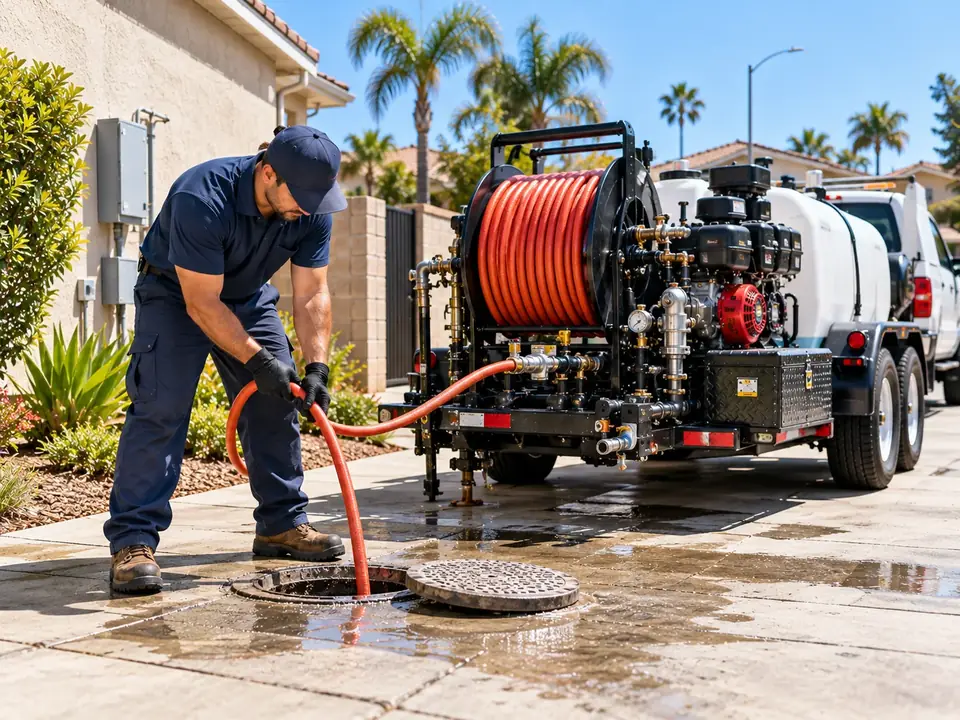
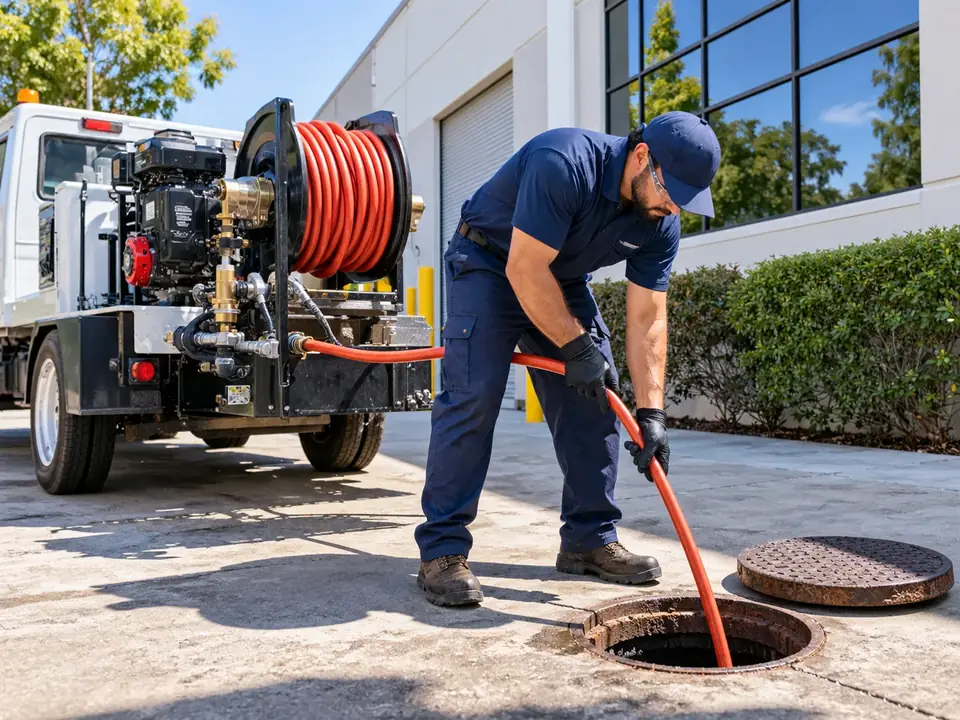
A house typically has a 4-inch lateral serving a few bathrooms and one kitchen. A restaurant, apartment building or shopping-center tenant row may have 4- to 6-inch building mains carrying many times that load, plus floor drains, floor sinks, three-compartment sinks and long horizontal runs where solids settle. Commercial jetting is built for that scale:
| Typical residential jetting | Typical commercial jetting | |
|---|---|---|
| Equipment | Portable or small trailer unit | Trailer- or truck-mounted jetter with a large water tank |
| Water flow | Lower flow for 1½–4″ lines | Higher flow (often in the high-teens of gallons per minute) to flush 4–6″ lines |
| Hose length | Enough for one lateral | Long hoses for runs serving multiple tenants |
| Hot water | Rarely | Hot-water jetters are available and can help with heavy grease |
| Scheduling | Daytime | Often before opening or after close |
| Paperwork | Invoice | Service records for managers, landlords and inspectors |
Pressure gets the attention, but in large lines flow does most of the work: it’s the volume of water that carries loosened grease and sediment out of the line instead of pushing it farther downstream to cause the next blockage.
Which businesses need it most
Restaurants & commercial kitchens
Grease from fryers, woks, grills and dish areas hardens in kitchen branches, floor sinks and the line to the grease interceptor.
Apartments, condos & HOAs
Shared kitchen stacks and building mains collect grease, wipes and paper from many households at once.
Retail & shopping centers
Long common sewer runs serve several tenants; one tenant’s habits can back up the whole row.
Medical, office & schools
High restroom traffic sends paper towels, gloves and wipes into lines that weren’t built for them.
Grease rules in Los Angeles County
If you run a food-service business, your drains don’t just affect you — grease that escapes your property clogs public sewers. That’s why local sewer agencies regulate it. In unincorporated Los Angeles County and the cities that contract with the County for this work, LA County Public Works’ Industrial Waste program regulates discharges into more than 3,000 miles of local sewers and issues Industrial Waste Disposal Permits.
The County’s restaurant pretreatment guidelines describe when a grease interceptor may be required — for example, establishments with 150 or more seats, those with heavy takeout or drive-thru volume, kitchens with grills, fryers, woks or barbecues, and businesses discharging to undersized or flat sewers — and set a minimum interceptor size of 750 gallons. They also specify which fixtures connect to the interceptor (pot sinks, mop sinks, floor sinks in prep areas) and which don’t (toilets, ice machines, and dishwashers or discharges above 140°F).
Inside the City of Whittier, requirements are set by the City; in unincorporated communities like South Whittier and West Whittier–Los Nietos, by the County. Either way, two points hold:
- Interceptor pumping and line jetting are different jobs. Pumping empties the interceptor. Jetting cleans the pipes between your fixtures and the interceptor — where grease hardens before it ever arrives.
- Keep records. Dates, lines cleaned and observations make inspections, lease conversations and budgeting easier.
Call to talk through your lines, access points and the best cleaning window for your operation.
How a commercial jetting visit should run
- Pre-visit call: property type, affected lines, cleanout and interceptor locations, operating hours, who approves work.
- Access & protection: cleanouts opened, work areas protected, and in kitchens, equipment moved only as agreed.
- Restore flow first if a line is backing up.
- Clean to full diameter with nozzles matched to the problem — rotating heads for grease, penetrators for packed debris, root cutters where needed.
- Camera verification on recurring or problem lines to confirm results and spot defects cleaning can’t fix.
- Written summary: lines cleaned, findings, and a recommended interval.
Scheduling around your business
- Restaurants: early morning before prep, or after close. Avoid the day before a known rush.
- Apartments: give tenants notice to avoid heavy water use during the visit.
- Retail centers: coordinate with property management for after-hours access and shared lines.
- Medical offices: schedule outside patient hours where restrooms will be affected.
What commercial jetting costs
National cost guides put an average residential jetting job around $475, with most between roughly $350 and $600. Commercial work usually costs more because of larger equipment, longer lines, multiple access points, after-hours timing and documentation. The biggest price drivers are:
- Number and length of lines (kitchen branches, building main, shared runs)
- Access — accessible cleanouts versus roof vents or fixture removal
- Severity of grease, scale or roots
- After-hours or emergency scheduling
- Camera inspection and written reporting
Ask for the scope in writing before work starts, and compare quotes by what’s included — not just the total.
Setting a maintenance interval
| Operation | Common starting interval |
|---|---|
| High-volume, fryer-heavy kitchen | About every 3 months |
| Café, bakery, light food service | Every 6–12 months |
| Apartment kitchen stacks & building main | Every 6–12 months |
| Office or medical restroom mains | As needed; often annually where wipes are an issue |
Treat these as starting points. Re-inspect after the first interval: if the line is still clean, stretch it; if buildup is heavy, shorten it — or price a permanent fix for any sag or defect that keeps collecting grease.
Choosing a commercial provider
- Verify the contractor’s license on the CSLB website and ask for proof of liability insurance.
- Ask what flow (GPM) and pressure their equipment delivers and whether they can jet your longest run.
- Confirm they’ll provide camera footage and a written summary.
- Ask how they handle a line that turns out to be damaged — they should stop and explain before changing the scope.
Frequently asked questions
What is commercial hydro jetting?
It’s high-pressure, high-volume water cleaning of commercial drain and sewer lines — restaurant kitchen lines, building mains and shared runs — using larger trailer- or truck-mounted jetters than residential work.
Is grease interceptor pumping the same as hydro jetting?
No. Pumping empties the interceptor; jetting cleans the pipes leading to it. Most food-service businesses need both on separate schedules.
How often should a restaurant have its lines jetted?
High-volume kitchens often start at quarterly cleaning; lighter operations at six to twelve months. Camera checks after cleaning help set the right interval.
Can commercial jetting be done after hours?
Yes. Early-morning and after-close scheduling is common so kitchens, tenants and patients aren’t disrupted.
Related services
- Commercial Hydro JettingRestaurants, retail centers, apartments and offices — high-volume lines jetted on a schedule that keeps your doors open.
- Grease & Sludge RemovalHardened grease and sludge scoured off the pipe wall — the kind of buildup a snake leaves behind.
- Preventive Drain MaintenanceScheduled jetting for restaurants, apartments and older homes — set by what the camera shows, not a sales calendar.
Call Precision Hydro Jetting. Describe the symptoms and get a straight answer on next steps.
Sources
- LA County Public Works — Industrial Waste program
- LA County Public Works — Restaurant Pretreatment Guidelines (PDF)
- Angi — How Much Does Hydro Jetting Cost?

Precision Hydro Jetting — drain and sewer cleaning for Whittier, CA. This guide is general information, not a diagnosis of a specific plumbing system; conditions vary by property.