Start with what the camera shows
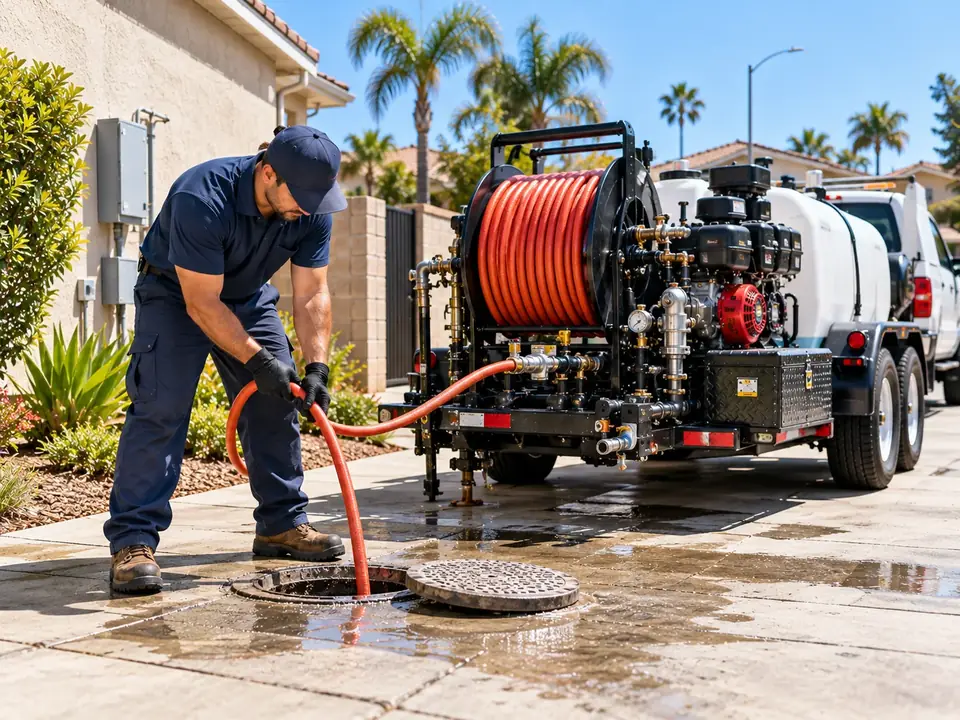
The right repair depends on three things a sewer camera inspection reveals: how many joints are affected, whether the pipe is still round and intact, and whether there are sags (bellies), offsets or collapsed sections. Have the line cleaned first — roots and grease hide defects — then inspected with a footage counter so each problem can be located from the cleanout. (Why cleaning and inspection go together.)
Your five options
1. Root cutting and maintenance cleaning
Hydro jetting with a root-cutting nozzle (or a mechanical cutter followed by jetting) clears roots back to the pipe wall. National guides put root removal at roughly $100–$600. It’s the right choice when the pipe is sound and only a few joints let roots in — but roots usually return through the same joints, often within one to three years.
2. Spot repair
A short section is excavated and replaced — useful when the damage is concentrated in one or two places, such as a cracked section near a tree or a failed joint under the yard. It’s often the least expensive permanent fix when the rest of the line is in good shape.
3. Cured-in-place pipe (CIPP) lining
After thorough cleaning, a resin-saturated liner is inserted and cured inside the old pipe, creating a seamless pipe-within-a-pipe with no joints for roots to enter. It requires little or no digging. The tradeoffs: it slightly reduces pipe diameter, it can’t fix a sag or a fully collapsed section, and the host pipe needs to be cleaned very well first.
4. Pipe bursting
A bursting head pulls new pipe (typically HDPE) through the old line, fracturing the old pipe outward. It needs access pits at each end but avoids trenching the whole run, and it can replace pipe that is too damaged to line.
5. Open-trench replacement
The traditional approach: dig along the line and replace it. It’s the most disruptive, but it’s the only option that can correct grade problems like a deep belly, and it may be simplest for short, shallow runs with nothing valuable on top.
Call to talk through whether cleaning, a spot repair or lining makes more sense for your line.
Side-by-side comparison
| Option | Typical national cost* | Stops root regrowth? | Fixes sags? | Digging |
|---|---|---|---|---|
| Root cutting / jetting | ~$100–$600 per visit | No — maintenance only | No | None |
| Spot repair | Varies by depth & length | In the repaired section | In that section | One excavation |
| CIPP lining | ~$80–$250 per foot | Yes, where lined | No | Minimal |
| Pipe bursting | ~$60–$200 per foot | Yes | Partly | Access pits |
| Open-trench replacement | ~$50–$250 per foot | Yes | Yes | Full trench |
*Ranges reported by Angi’s cost guides. Southern California pricing often runs higher, and permits, depth, access, concrete and landscaping restoration add to the total. Treat these as context, not a quote.
How to decide
- Roots at a few joints, pipe round and intact: scheduled root cutting, or spot repair of the worst joint.
- Roots at many joints, pipe intact, no sags: lining is often the best value.
- Cracked, broken or Orangeburg pipe: pipe bursting or replacement.
- Significant belly holding water: excavation of that section, since lining follows the existing grade.
- Cleaning needed every 6–12 months: compare five years of maintenance against a permanent fix — the repair often wins.
Permits and paperwork in Whittier and LA County
Sewer lateral repairs generally require permits. In the City of Whittier, Public Works’ process for lateral repairs includes submitting a lateral video showing the line from the cleanout to the City main, and if repairs are needed, the lateral is re-videoed after the work. Work in the street or parkway may require additional permits. In unincorporated LA County, the property owner owns the entire lateral, including the portion under the street, so ask your contractor which County permits apply. Confirm current requirements with the agency before work begins.
Questions to ask before you approve a repair
- Can you show me on the video exactly where the damage is, with footage-counter distances?
- Why this method and not a spot repair or lining?
- Does the price include permits, the City’s lateral video, cleanout installation and surface restoration?
- What warranty applies to the repair, and what does it cover?
- Is your CSLB license active, and in which classification?
Frequently asked questions
Is pipe lining better than replacing a sewer line?
For a pipe that is intact but has root-infiltrated joints, lining is often less disruptive and cost-effective. It can’t fix sags or collapsed sections, which need excavation or bursting.
How much does it cost to fix a root-damaged sewer line?
It depends on length, depth and method. National guides put lining around $80–$250 per foot, pipe bursting around $60–$200 per foot, and root removal visits around $100–$600. Local pricing and permits add to that.
Should I remove the tree causing root problems?
Usually not first. Roots already in the pipe remain, and sealing the pipe through lining or repair typically solves the problem while keeping the tree.
Do I need a permit for sewer lateral repair in Whittier?
Generally yes. The City’s Public Works process for lateral repairs includes a lateral video review. Confirm current requirements with the City before scheduling work.
Related services
- Tree Root Intrusion CleaningRoots growing into old clay sewer joints cut back to the pipe wall with root-cutting jet nozzles — plus a plan to slow regrowth.
- Sewer Line Hydro JettingClean the lateral from your house to the street main — roots, grease and sludge removed, not just pushed aside.
- Recurring Drain Clog RepairSame drain, same clog, every few months? We find the cause behind the pattern and fix that — not just the symptom.
Call Precision Hydro Jetting. Describe the symptoms and get a straight answer on next steps.
Sources
- Angi — Trenchless Sewer Line Cost
- Angi — Sewer Line Repair & Replacement Cost
- City of Whittier — Sewer Lateral Video Requirements
- LA County Public Works — Sewer Maintenance Customer Information

Precision Hydro Jetting — drain and sewer cleaning for Whittier, CA. This guide is general information, not a diagnosis of a specific plumbing system; conditions vary by property.